
Featured in NCPS Magazine (August 2026)
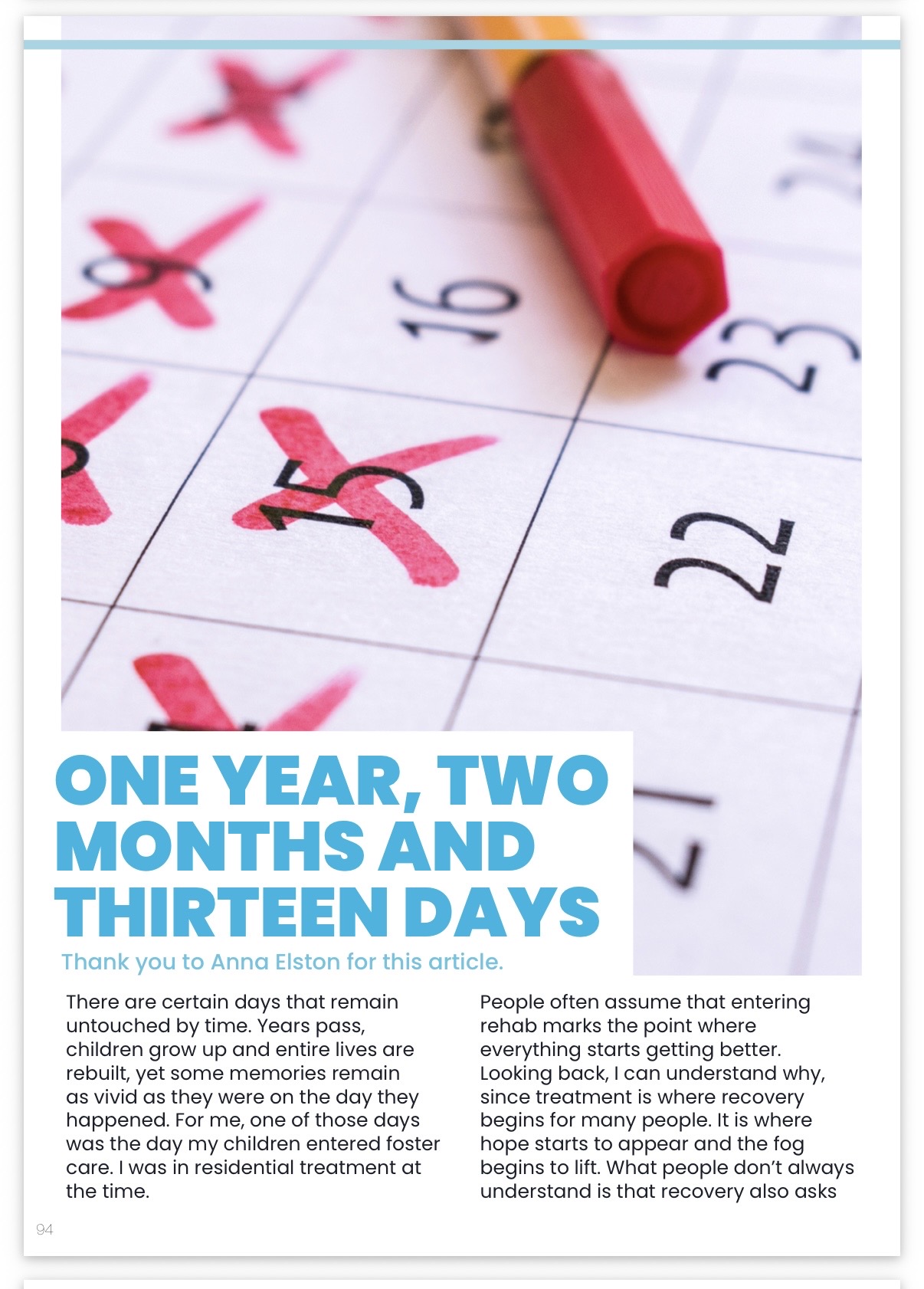
One Year, Two Months and Thirteen Days
I’m pleased to have contributed an article to the August 2026 edition of the National Counselling & Psychotherapy Society (NCPS) Magazine.
The article explores recovery, shame, trauma and the lasting impact addiction can have on individuals and families. It also reflects on how my own experiences continue to shape my work as an Accredited Addictions Counsellor and Clinical Supervisor. Read more about me.
Originally published in NCPS Counselling Matters Magazine (August 2026). Reproduced with permission.
One Year, Two Months and Thirteen Days
By Anna Elston
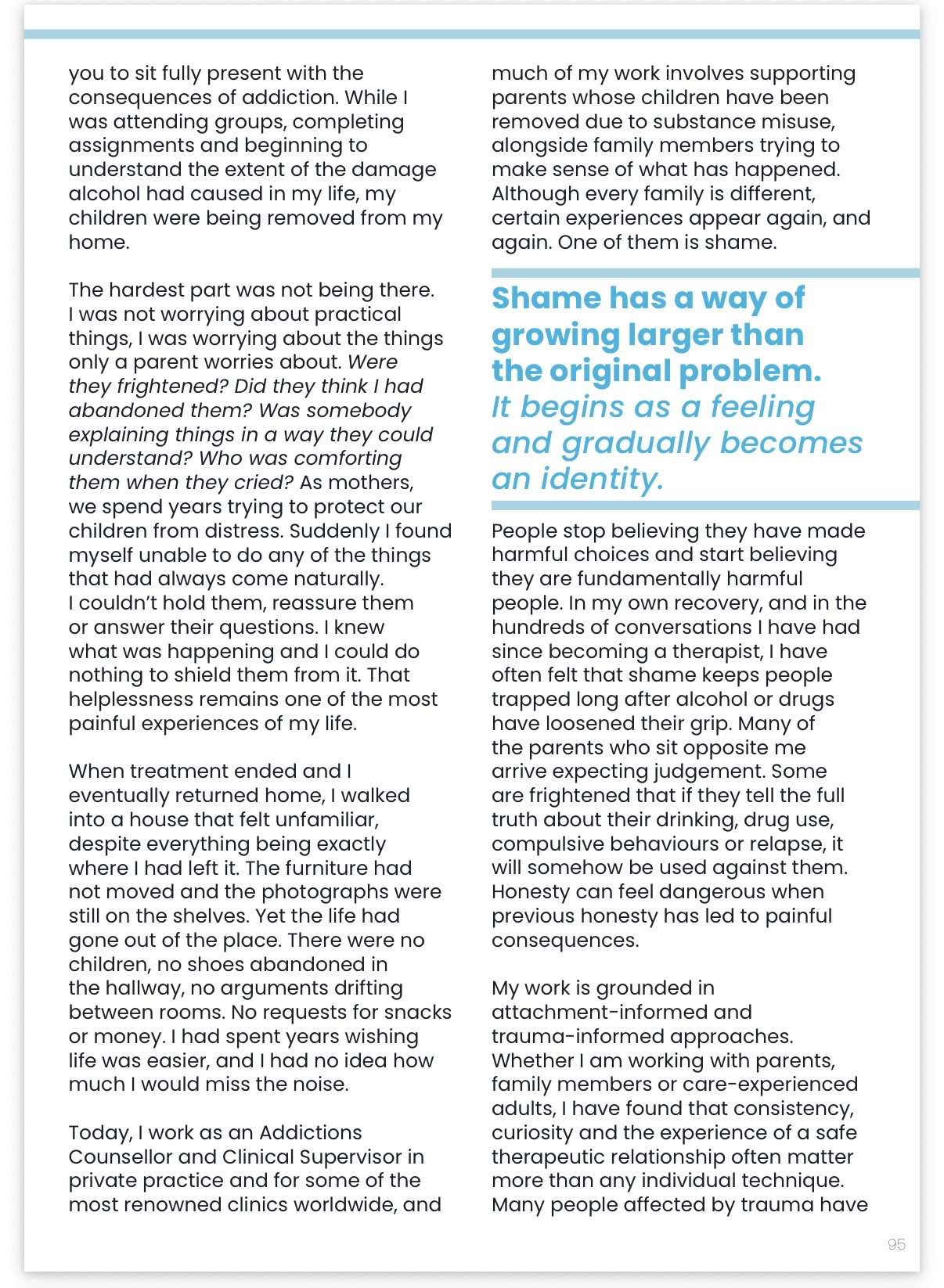
There are certain days that remain untouched by time. Years pass, children grow up and entire lives are rebuilt, yet some memories remain as vivid as they were on the day they happened. For me, one of those days was the day my children entered foster care. I was in residential treatment at the time.
People often assume that entering rehab marks the point where everything starts getting better. Looking back, I can understand why, since treatment is where recovery begins for many people. It is where hope starts to appear and the fog begins to lift. What people don’t always understand is that recovery also asks you to sit fully present with the consequences of addiction. While I was attending groups, completing assignments and beginning to understand the extent of the damage alcohol had caused in my life, my children were being removed from my home.
The hardest part was not being there. I was not worrying about practical things, I was worrying about the things only a parent worries about. Were they frightened? Did they think I had abandoned them? Was somebody explaining things in a way they could understand? Who was comforting them when they cried? As mothers, we spend years trying to protect our children from distress. Suddenly I found myself unable to do any of the things that had always come naturally. I couldn’t hold them, reassure them or answer their questions. I knew what was happening and I could do nothing to shield them from it. That helplessness remains one of the most painful experiences of my life.
When treatment ended and I eventually returned home, I walked into a house that felt unfamiliar, despite everything being exactly where I had left it. The furniture had not moved and the photographs were still on the shelves. Yet the life had gone out of the place. There were no children, no shoes abandoned in the hallway, no arguments drifting between rooms. No requests for snacks or money. I had spent years wishing life was easier, and I had no idea how much I would miss the noise.
Today, I work as an Addictions Counsellor and Clinical Supervisor in private practice and for some of the most renowned clinics worldwide, and much of my work involves supporting parents whose children have been removed due to substance misuse, alongside family members trying to make sense of what has happened. Although every family is different, certain experiences appear again, and again. One of them is shame.
Shame has a way of growing larger than the original problem. It begins as a feeling and gradually becomes an identity. People stop believing they have made harmful choices and start believing they are fundamentally harmful people. In my own recovery, and in the hundreds of conversations I have had since becoming a therapist, I have often felt that shame keeps people trapped long after alcohol or drugs have loosened their grip. Many of the parents who sit opposite me arrive expecting judgement. Some are frightened that if they tell the full truth about their drinking, drug use, compulsive behaviours or relapse, it will somehow be used against them. Honesty can feel dangerous when previous honesty has led to painful consequences.
My work is grounded in attachment-informed and trauma-informed approaches. Whether I am working with parents, family members or care-experienced adults, I have found that consistency, curiosity and the experience of a safe therapeutic relationship often matter more than any individual technique. Many people affected by trauma have spent years adapting in order to survive. Therapy can provide a space where those adaptations are understood with compassion rather than judgement. What they are often carrying is not simply guilt about what has happened. They are carrying grief.
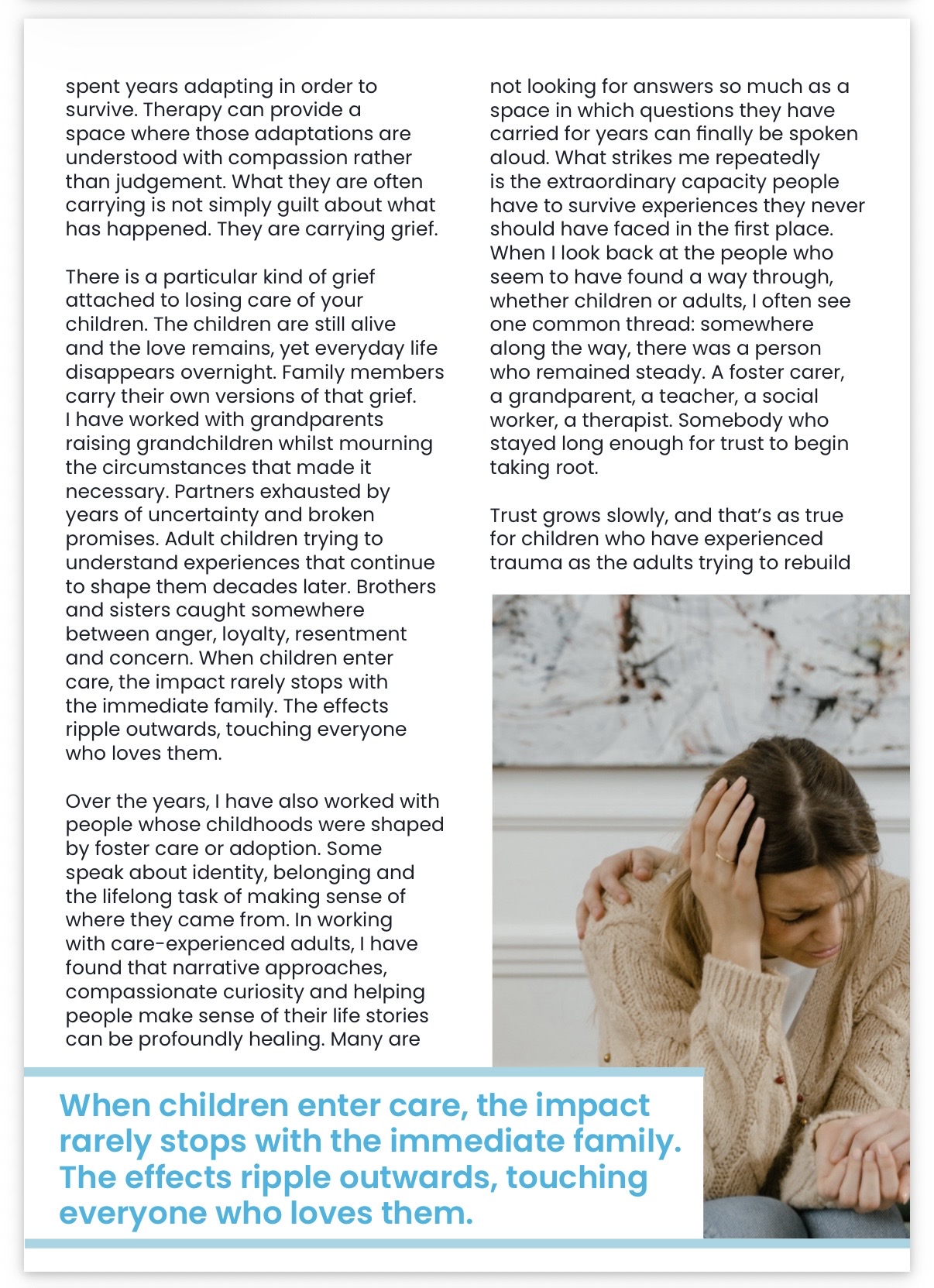
There is a particular kind of grief attached to losing care of your children. The children are still alive and the love remains, yet everyday life disappears overnight. Family members carry their own versions of that grief. I have worked with grandparents raising grandchildren whilst mourning the circumstances that made it necessary. Partners exhausted by years of uncertainty and broken promises. Adult children trying to understand experiences that continue to shape them decades later. Brothers and sisters caught somewhere between anger, loyalty, resentment and concern. When children enter care, the impact rarely stops with the immediate family. The effects ripple outwards, touching everyone who loves them.
Over the years, I have also worked with people whose childhoods were shaped by foster care or adoption. Some speak about identity, belonging and the lifelong task of making sense of where they came from. In working with care-experienced adults, I have found that narrative approaches, compassionate curiosity and helping people make sense of their life stories can be profoundly healing. Many are not looking for answers so much as a space in which questions they have carried for years can finally be spoken aloud. What strikes me repeatedly is the extraordinary capacity people have to survive experiences they never should have faced in the first place. When I look back at the people who seem to have found a way through, whether children or adults, I often see one common thread: somewhere along the way, there was a person who remained steady. A foster carer, a grandparent, a teacher, a social worker, a therapist. Somebody who stayed long enough for trust to begin taking root.
Trust grows slowly, and that’s as true for children who have experienced trauma as the adults trying to rebuild their lives after addiction. My own recovery eventually allowed me to rebuild relationships with my children and welcome them home again. They were allowed by the courts to return when I had been sober for eight months. By then, one year, two months and thirteen days had passed since they had entered foster care.
I know that because I counted every single day.
Their return was unusual. The professionals involved believed sufficient change had taken place and that my children could safely come home. Even now, I am careful when talking about that part of my story. Not every parent receives the outcome they hope for, and some of the families I work with are living a very different reality. What I do understand, however, is the long road between losing trust and beginning to earn it back.
Recovery has taught me something I had never fully understood before. The people who loved me were not waiting for promises, they were waiting for consistency, and to see me do something differently. Over several months, not days. If I could change one thing, it would be earlier access to specialist support for families affected by addiction. Too often, help arrives at the point of crisis rather than at the point of struggle. By the time children enter care, families have often been living with fear, secrecy and uncertainty for many years.
Working in this field has changed my understanding of healing. Earlier in my career, I probably viewed recovery as a destination, but two decades on, it feels more like an ongoing process of learning how to live honestly, repairing what can be repaired and finding ways to be accepting of the things that can’t. It has also deepened my respect for foster carers, adoptive parents, social workers and professionals who support children through extraordinarily difficult circumstances. Much of their work goes unseen, unfolding in school runs, bedtime routines and countless acts of consistency that help children feel safe enough to begin trusting again.
The day my children entered foster care remains one of the most painful days of my life. It is also one of the reasons I do the work I do today. Every week I sit with parents, grandparents, partners and family members whose lives have been touched by addiction. Some are desperately trying to prevent the loss of a child. Some are attempting to rebuild relationships after years of separation. Some are standing helplessly on the sidelines, watching somebody they love struggle. I can’t tell them how their stories will end, but what I can offer is an understanding of the fear, grief, shame and helplessness that so often accompany these experiences. I know what it is like to sit in treatment while your children enter care. I know what it feels like to come home to an empty house. I know what it’s like to count days, weeks and months whilst desperate for a second chance when nobody is giving you any answers or a guidebook.
Most of all, I know that people are far more than the worst chapter of their lives. Yet after everything I’ve experienced, both personally and professionally, I continue to see people finding ways to progress, learn, grow and find joy again. What I’ve learned is that healing rarely looks the way we expect it to. What matters is that people are given the hope, opportunity, support and compassion to begin.
If this article has raised something you’d like to talk about, or you’re looking for support for yourself or someone close to you, please get in touch via my Contact page.